



Latest NRAO News
News is managed by NRAO News & Public Information. Questions about News? Have a story to share? Want to interview a scientist or create new media about our telescopes?
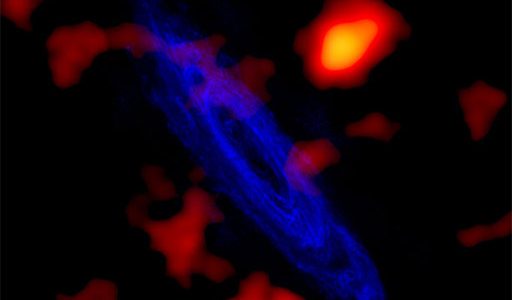
Green Bank, WV – A team of astronomers using the National Science Foundation’s Green Bank Telescope has made the first conclusive detection of what appear to be the leftover building blocks of galaxy formation — neutral hydrogen clouds — swarming around the Andromeda Galaxy, the nearest large spiral galaxy to the Milky Way.

New observations with National Science Foundation’s Green Bank Telescope suggest that what was once believed to be an intergalactic cloud of unknown distance and significance, is actually a previously unrecognized satellite galaxy of the Milky Way orbiting backward around the Galactic center.
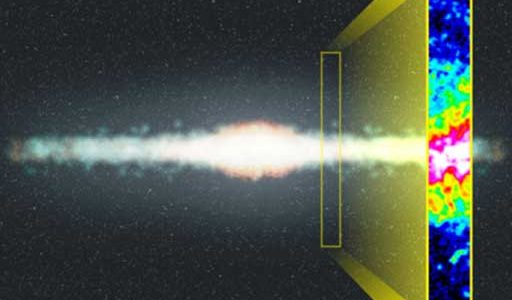
Using the exquisite sensitivity of the National Science Foundation’s Green Bank Telescope, astronomer Jay Lockman of the National Radio Astronomy Observatory in Green Bank, West Virginia, has produced the best cross-section ever of the Milky Way Galaxy’s diffuse halo of hydrogen gas.

GREEN BANK, WV — New studies with the National Science Foundation’s Robert C. Byrd Green Bank Telescope (GBT) have revealed a previously unknown population of discrete hydrogen clouds in the gaseous halo that surrounds the Milky Way Galaxy.

Astronomers using the National Science Foundation’s newly commissioned Green Bank Telescope have detected remarkably faint radio signals from an 820 year-old pulsar, making it the youngest radio-emitting pulsar known.

Combining the best features of the National Science Foundation’s new Green Bank Telescope in West Virginia with those of the NSF’s Very Large Array in New Mexico, astronomers have produced a vastly improved radio image of the Orion Nebula and developed a valuable new technique for studying star formation and other astrophysical processes.
Astronomers using the National Science Foundation’s newly commissioned Robert C. Byrd Green Bank Telescope (GBT) have discovered a windfall of three previously undetected millisecond pulsars in a dense cluster of stars in the Milky Way Galaxy.

The world’s two largest radio telescopes have combined to make detailed radar images of the cloud-shrouded surface of Venus and of a tiny asteroid that passed near the Earth.
A decision has been reached by the arbitrator in the dispute between COMSAT Corporation, now part of Lockheed-Martin Global Telecommunications, and Associated Universities, Inc regarding additional costs on the contract to design and construct the Green Bank Telescope.

At a ceremony last Friday, August 25 in which the National Science Foundation’s Green Bank Telescope was formally dedicated, U.S. Senator Robert C Byrd announced that the gigantic telescope had successfully opened its two-acre ‘eye’ on the Universe earlier that week.