

Latest NRAO News

News is managed by NRAO News & Public Information. Questions about News? Have a story to share? Want to interview a scientist or create new media about our telescopes?
RSS

Search Results

Search Terms: ALMA

Showing results 31 - 40 of 321
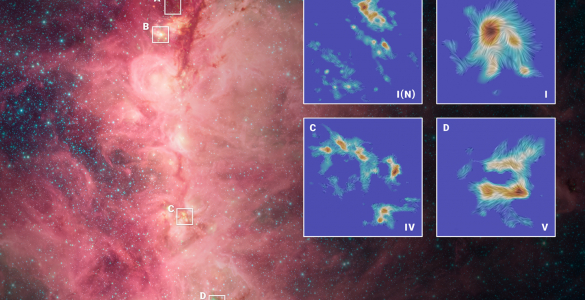
This image from NASA’s Spitzer Space Telescope shows a star formation region in molecular cloud NGC 6334, also known as the Cat's Paw Nebula. The colors correspond with emission at 3.6 microns (blue), 4.5 microns (green), and 8 microns (red). This cloud is actively forming massive stars, and is located in the constellation Scorpius, between 4,200 to 5,500 light-years from Earth. ALMA data overlaid on the image shows details of four specific areas that were observed (NGC6334I, NGC6334I(N), NGC6334IV and NGC6334V), revealing invisible forces of magnetism and gravity as they wrestle and shape the formation of stars deep within the giant molecular cloud. The color scale in the ALMA images represents the intensity of the dust emission at 1.3mm and the drapery lines represent the orientation of the magnetic field.
Cosmic Tug-of-War: Gravity Reshapes Magnetic Fields in Star Clusters
October 8, 2025 at 10:48 am | News Release

Astronomers have captured the clearest picture yet of how massive stars are born, revealing a dramatic interplay between gravity…
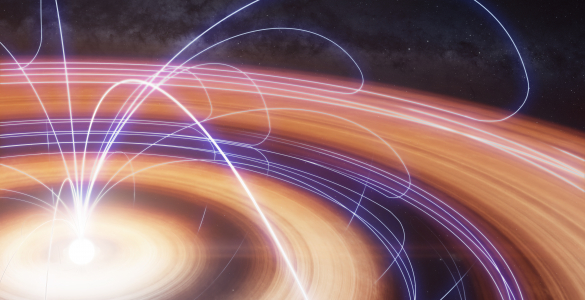
colorful rings surrounding a star with lines weaving up and down through them
Astronomers Reveal Planet Building’s Secret Ingredient: Magnetism
September 12, 2025 at 12:01 pm | News Release

Astronomers have created a detailed map revealing the magnetic fields weaving through TW Hydrae, one of the closest known…
colorful rings surrounding a star with lines weaving up and down through them
A Million Reasons to Celebrate: NSF NRAO Hits One Million Citations
September 8, 2025 at 11:07 am | News Release

The U.S. National Science Foundation National Radio Astronomy Observatory (NSF NRAO) is celebrating a historic achievement: research using our…
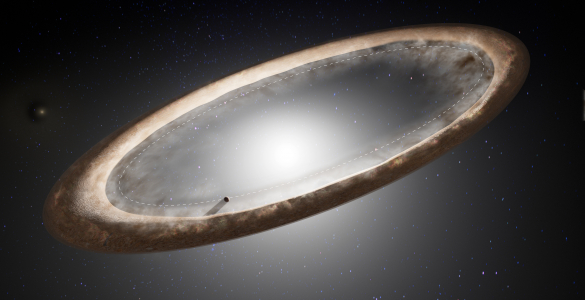
The bright star in the center, Fomalhaut, is surrounded by an ancient debris disk of uneven brightness. The disk is closer to the star in the south, where the disk is wider and fainter, and further from the star in the north, where the disk is narrower and brighter. The dotted ring shows the possible orbit of a planet implied by Lovell et al.
Neighboring Star’s Warped Ring Shaped by Evolving Planets
September 4, 2025 at 12:00 pm | News Release

Astronomers using the Atacama Large Millimeter/submillimeter Array (ALMA) have made the highest resolution image to date, revealing new insights…

Origins of Earth’s Water. Terrestrial H2O is thought to have been delivered several billion years ago, by a combination of cometary, asteroidal and meteoritic impacts. In contrast to previous findings, new work using the ALMA telescope shows that the isotopic (D/H) ratio in Earth’s water is consistent with delivery by Halley-type comets.
Comet’s Water Holds Clues to Life on Earth
August 8, 2025 at 5:00 am | News Release

New research has uncovered compelling evidence that water from a comet is strikingly similar to that found in Earth’s…

An artist’s impression of the “Cosmic Grapes” galaxy, composed of at least 15 massive star forming clumps—far more than current theoretical models predict could exist within a single rotating disk at this early time. Image credit NSF/AUI/NSF NRAO/B.Saxton.
The Universe’s Secret Harvest: ALMA Sheds Light on “the Cosmic Grapes”
August 7, 2025 at 8:27 am | News Release

Astronomers have discovered a remarkably clumpy rotating galaxy that existed just 900 million years after the Big Bang, shedding…
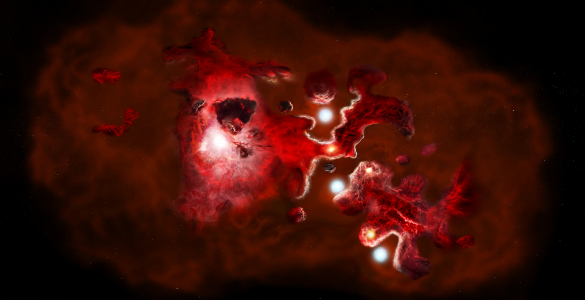
This artist's impression of the formation of an early universe galaxy featuring clumps of star-forming galaxies, with carbon gas shown in red, and dark dust shown in black. This process is documented in detail throughout the many galaxies observed in ALMA’s CRISTAL survey.
ALMA Reveals Stunning Details of Infant Galaxies in the Early Universe
July 1, 2025 at 11:00 am | News Release

Astronomers are getting a much clearer picture of what galaxies looked like in the early Universe, thanks to a…

An artist rendition of comet C/2014 UN271, the largest known comet in the Oort Cloud.
Largest Oort Cloud Comet Ever Observed Reveals Its Secrets with ALMA’s Powerful Gaze
June 16, 2025 at 9:46 pm | News Release

A team of astronomers has made a groundbreaking discovery by detecting molecular activity in comet C/2014 UN271 (Bernardinelli-Bernstein)—the largest…

Artist’s concept of protoplanetary disk, like the thirty studied for the ALMA AGE-PRO survey. The lifetime of the gas within the disk determines the timescale for planetary growth.
ALMA Reveals Lives of Planet-Forming Disks
June 13, 2025 at 9:00 am | News Release

An international team of astronomers has unveiled groundbreaking findings about the disks of gas and dust surrounding nearby young…

Large dust grains observed surrounding outflows of young protostellar binary system L1551 IRS5.
From Stardust to Stone: Windswept Grains Hold Clues to Planet’s Beginnings
June 12, 2025 at 9:00 am | News Release

The Atacama Large Millimeter/submillimeter Array (ALMA) has uncovered a key piece of the puzzle in how rocky planets, such…

Showing results 31 - 40 of 321