


Latest NRAO News

News is managed by NRAO News & Public Information. Questions about News? Have a story to share? Want to interview a scientist or create new media about our telescopes?

RSS

Search Results

Search Terms: GBT

Showing results 31 - 40 of 132
Partially processed view of the Tycho Crater at a resolution of nearly five meters by five meters and containing approximately 1.4 billion pixels, taken during a radar project by Green Bank Observatory, National Radio Astronomy Observatory, and Raytheon Intelligence & Space using the Green Bank Telescope and antennas in the Very Long Baseline Array. This image covers an area 200km by 175km, which is large enough to contain the 86km-diameter Tycho Crater.
Astronomical Radar: Illuminating our Understanding of the Solar System
December 15, 2021 at 1:30 pm | News Feature

Astronomers study the universe by capturing light from the sky, but they can also learn thing by sending radio light into space.

The National Radio Astronomy Observatory (NRAO), Green Bank Telescope, and Raytheon Intelligence & Space (RI&S) are working in collaboration to improve planetary radar capabilities. With the addition of Qorvo's Spatium power amplifier technology, the project now has the power to identify and characterize even small NEOs earlier with more precision.
Qorvo Provides Key Enabling Technology for Identifying, Mapping and Tracking Threats from Near-Earth Objects  
June 8, 2021 at 5:00 am | Announcement

NRAO, Green Bank Telescope, and Raytheon Intelligence & Space (RI&S) are working in collaboration to improve planetary radar capabilities. With the addition of Qorvo’s Spatium power amplifier technology, the project now has the power to identify and characterize even small NEOs earlier with more precision.

GBT-VLBA radar image of the region where Apollo 15 landed in 1971. The snake-like feature is Hadley Rille, a remnant of ancient volcanic activity, probably a collapsed lava tube. The crater at top, alongside the rille, is called Hadley C and is about 6 kilometers in diameter. This image shows objects as small as 5 meters across.
Successful Test Paves Way for New Planetary Radar
January 28, 2021 at 10:00 am | News Release

Collaboration between the National Radio Astronomy Observatory, the Green Bank Observatory, and Raytheon Intelligence & Space turns the Green Bank Telescope and the Very Long Baseline Array into a radar system for studying the Solar System.

Artist's impression of white dwarf and pulsar
Most Massive Neutron Star Ever Detected, Almost too Massive to Exist
September 16, 2019 at 1:08 pm | News Release

Astronomers using the GBT have discovered the most massive neutron star to date, a rapidly spinning pulsar approximately 4,600 light-years from Earth. This record-breaking object is teetering on the edge of existence, approaching the theoretical maximum mass possible for a neutron star.

Artist's impression of the explosion and burst of gravitational waves emitted when a pair of superdense neutron stars collide. New observations with radio telescopes show that such events can be used to measure the expansion rate of the Universe.
New Method May Resolve Difficulty in Measuring Universe’s Expansion
July 8, 2019 at 11:00 am | News Release

Radio telescope observations have made it possible for astronomers to use mergers of neutron-star pairs as a valuable new tool for measuring the Universe’s expansion.

Artist impression of PSR J0337+1715
Even Phenomenally Dense Neutron Stars Fall like a Feather
June 26, 2018 at 5:00 pm | News Release

Harnessing the exquisite sensitivity of the GBT, astronomers have given one of Einstein’s predictions on gravity its most stringent test yet. By precisely tracking the meanderings of three stars in a single system – two white dwarf stars and one ultra-dense neutron star – the researchers determined that even the most massive of objects “fall” in the same manner as their less-dense counterparts.

Taurus Molecular Cloud with benzonitrile model
GBT Detection Unlocks Exploration of ‘Aromatic’ Interstellar Chemistry
January 11, 2018 at 9:10 am | News Release

Astronomers using the GBT have made the first definitive interstellar detection of benzonitrile, an intriguing organic molecule.

TS_16-07
NRAO Media Tip Sheet: July 2016
July 1, 2016 at 11:30 am | Tip Sheet

VLA points to previously unknown galaxy cluster, GBT gets new vision, and ALMA uses double vision.

Graphic illustrating location of chiral molecules
Life’s First Handshake: Chiral Molecule Detected in Interstellar Space
June 14, 2016 at 5:15 pm | News Release

Scientists applaud discovery of “handed” molecules in interstellar space.
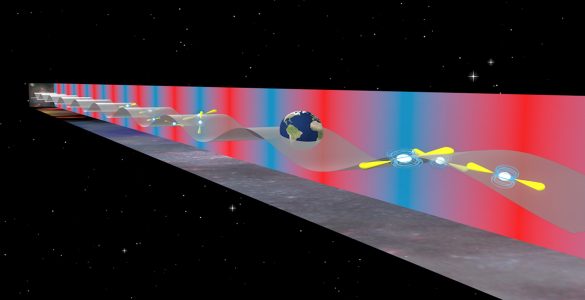
Artist's conception of gravitational waves interacting with pulsars
Gravitational Wave Search Provides Insights into Galaxy Evolution and Mergers
April 5, 2016 at 3:00 pm | News Release

NANOGrav provides insights into galaxy mergers.

Showing results 31 - 40 of 132