Skip to content
  • For Scientists arrow_outward
NSF Logo Icon
NRAO Logo
  • News
  • Gallery
  • Telescopes
    • VLA
    • ALMA
    • VLBA
    • GBT
    • ngVLA
  • Tech
    • CDL
    • Spectrum Management
    • ngRADAR
    • VLASS
  • Visit Us
    • Visit VLA
    • Visit ALMA
    • Visit GBO
  • Learn
    • What is Radio Astronomy?
    • Black Holes
    • Exoplanets
    • Pulsars Astronomy
    • Eclipse Basics
    • Blogs
    • Outreach Programs & Events
  • Explore
    • Cosmic Coloring Compositor
    • Interferometry Explained
    • NRAO Mission Control
  • Join & Give
  • Home
  • chevron_right
  • News
  • chevron_right
  • Death and Birth of Stars

Death and Birth of Stars


The Robert C. Byrd Green Bank Telescope.

Youngest Radio Pulsar Revealed with Green Bank Telescope

Posted on April 15, 2002November 20, 2019

Astronomers using the National Science Foundation’s newly commissioned Green Bank Telescope have detected remarkably faint radio signals from an 820 year-old pulsar, making it the youngest radio-emitting pulsar known.

Death and Birth of Stars
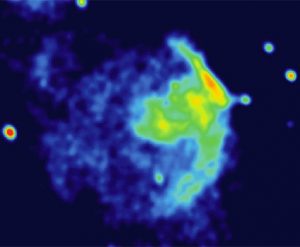
Infrared Image of Supernova Remnant; Dashed Line and Arrow Indicate Pulsar's Motion Detected by VLA.

Age Discrepancy Throws Pulsar Theories into Turmoil

Posted on March 11, 2002April 4, 2017

Astronomers using the National Science Foundation’s Very Large Array radio telescope have found a pulsar — a spinning, superdense neutron star — that apparently is considerably younger than previously thought.

Death and Birth of Stars
GBT-VLA Image of Orion Nebula.

GBT, VLA Team Up to Produce New Image of Orion Nebula

Posted on January 10, 2002April 4, 2017

Combining the best features of the National Science Foundation’s new Green Bank Telescope in West Virginia with those of the NSF’s Very Large Array in New Mexico, astronomers have produced a vastly improved radio image of the Orion Nebula and developed a valuable new technique for studying star formation and other astrophysical processes.

Death and Birth of Stars
L57

Stars Need a ‘Kick’ to Get Started

Posted on January 7, 2002April 4, 2017

Star formation is a longer process than previously thought, and is heavily dependent on outside events, such as supernova explosions, to trigger it, a team of astronomers has concluded. The scientists reached their conclusions after making a detailed study of a number of the dark gas clouds in which new stars are formed.

Death and Birth of Stars
The Robert C. Byrd Green Bank Telescope.

Newly Commissioned GBT Bags New Pulsars

Posted on January 4, 2002November 15, 2019

Astronomers using the National Science Foundation’s newly commissioned Robert C. Byrd Green Bank Telescope (GBT) have discovered a windfall of three previously undetected millisecond pulsars in a dense cluster of stars in the Milky Way Galaxy.

Death and Birth of Stars
Planetary Nebula K3-35

Star Caught in the Act of Planetary Nebula Formation

Posted on November 15, 2001April 4, 2017

A team of astronomers using the National Science Foundation’s Very Large Array radio telescope has caught an old star during the very brief period of its transformation into a planetary nebula, a shining bubble of glowing gas with a hot remnant star at its center.

Death and Birth of Stars

Posts navigation

  • « Previous
  • 1
  • …
  • 28
  • 29
  • 30
  • 31
  • 32
  • 33
  • 34
  • …
  • 36
  • Next »

Connect with NRAO

mail
Tweets by TheNRAO
The National Radio Astronomy Observatory is a facility of the U.S. National Science Foundation operated under cooperative agreement by Associated Universities, Inc.
Founded in 1956, the NRAO provides state-of-the-art radio telescope facilities for use by the international scientific community. NRAO telescopes are open to all astronomers regardless of institutional or national affiliation. Observing time on NRAO telescopes is available on a competitive basis to qualified scientists after evaluation of research proposals on the basis of scientific merit, the capability of the instruments to do the work, and the availability of the telescope during the requested time. NRAO also provides both formal and informal programs in education and public outreach for teachers, students, the general public, and the media.
The U.S. National Science Foundation (NSF) is an independent federal agency created by Congress in 1950 "to promote the progress of science; to advance the national health, prosperity, and welfare; to secure the national defense..."
AUI collaborates with the scientific community and research sponsors to plan, build, and operate cutting-edge facilities. We cultivate excellence, deliver value, enhance education, and engage the public.
  • News
  • Gallery
  • Telescopes
    • VLA
    • ALMA
    • VLBA
    • GBT
    • ngVLA
  • Tech
    • CDL
    • Spectrum Management
    • ngRADAR
    • VLASS
  • Visit Us
    • Visit VLA
    • Visit ALMA
    • Visit GBO
  • Learn
    • What is Radio Astronomy?
    • Black Holes
    • Exoplanets
    • Pulsars Astronomy
    • Eclipse Basics
    • Blogs
    • Outreach Programs & Events
  • Explore
    • Cosmic Coloring Compositor
    • Interferometry Explained
    • NRAO Mission Control
  • Join & Give
  • For Scientists
  • About NRAO
  • Ask an Astronomer
  • Historical Archives
  • Media Use
  • Social Media Policy
  • NRAO Library
  • Central Development Lab
  • Technology Transfer
  • Employee Services
  • Visitor Code of Conduct
  • Careers

Contact Us

NRAO Headquarters
520 Edgemont Road
Charlottesville, VA 22903
434-296-0211
More Information Here

© 2026 The National Radio Astronomy Observatory