Over the course of two scientific meetings, held in 2022 and 2023, German astronomers have collected 41 highly compelling science cases involving 57 unique authors from 19 German institutions, all aspiring to use the ngVLA.
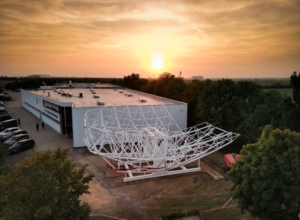
German tech factory reveals antenna prototype—ngVLA will open a new window into the Universe
Usually it’s Octoberfest that draws a crowd to Germany this time of year. For hundreds of folks gathered at…
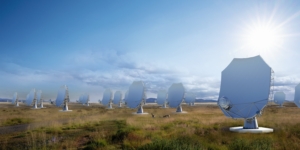
$21 Million NSF Award Will Bring ngVLA Design to Life
The largest astronomical array in North America is one step closer to becoming a reality. The National Radio Astronomy Observatory (NRAO) is pleased to announce that the National Science Foundation (NSF) has awarded a 3-year, $21 million grant to Associated Universities, Inc.(AUI) to further the design of the next generation Very Large Array (ngVLA).
Largest Telescope Array in North America Under Development by NRAO With Support from UNM
Through this partnership, NRAO and UNM will explore the potential of establishing the UNM College of Arts & Sciences’ Department of Physics & Astronomy as a host site for the ngVLA Data Processing and Science Operations Center.
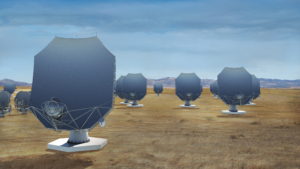
Design Review for ngVLA Antenna Clears Way for Prototype Construction
The design for the ngVLA prototype antenna has passed a thorough review by a panel of external experts and the project now is cleared to proceed to manufacture the prototype.