
Latest NRAO News

News is managed by NRAO News & Public Information. Questions about News? Have a story to share? Want to interview a scientist or create new media about our telescopes?

RSS
Showing news items 251 - 260 of 982
Image of ten pulsars in the Terzan 5 globular cluster
Telescope Tag-Team Discovers Galactic Cluster’s Bizarre Secrets
July 16, 2024 at 8:59 am | News Release

Towards the center of our Milky Way Galaxy, in the constellation Sagittarius, astronomers have discovered 10 monstrous neutron stars. Astronomers already knew that 39 pulsars call Terzan 5 home. With the teamwork of the U.S. National Science Foundation Green Bank Telescope (NSF GBT) and the South African Radio Astronomy Observatory’s MeerKAT Telescope, ten more have been added to the count.

Old Data, New Tricks Discover Pulsar in Galactic Plane
July 3, 2024 at 10:00 am | News Release

A team of astronomers has found a new tool to discover pulsars. Pulsars are rapidly rotating neutron stars that blast out pulses of radiation at regular intervals ranging from seconds to milliseconds.
Credit: Jeff Hellerman
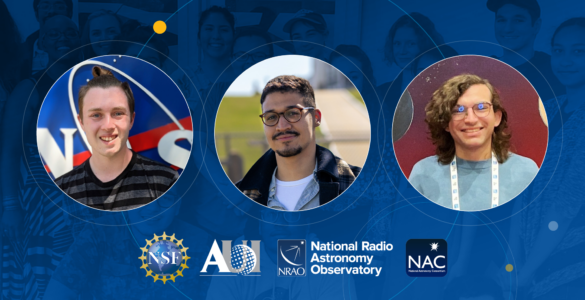
AUI and the NSF NRAO Announce the Recipients of the 2024 AUI Board of Trustees NAC Bridge Scholarship Award
July 1, 2024 at 11:33 am | News Release

AUI and the U.S National Science Foundation National Radio Astronomy Observatory (NSF NRAO) have announced the recipients of the…
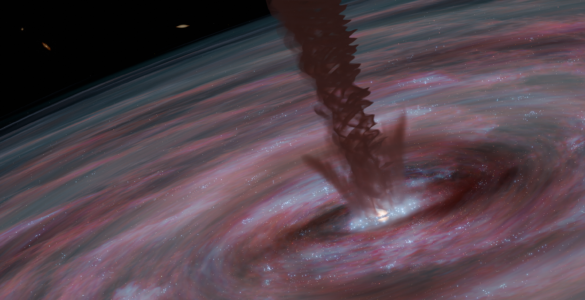
Assisted by magnetic fields, a spiraling wind helps the supermassive black hole in galaxy ESO320-G030 grow. In this illustration, the core of the galaxy is dominated by a rotating wind of dense gas leading outwards from the (hidden) supermassive black hole at the galaxy’s center. The motions of the gas, traced by light from molecules of hydrogen cyanide, have been measured with the Atacama Large Millimeter/submillimeter Array.
Supermassive Black Hole Appears to Grow Like a Baby Star
June 20, 2024 at 9:53 am | News Release

How do supermassive black holes get so big? An international team of astronomers, including scientists at the U.S. National Science Foundation National Radio Astronomy Observatory (NSF NRAO) have discovered a powerful, rotating, magnetic wind that they believe is helping a galaxy’s central supermassive black hole to grow. 

Engineers Descend upon DC for International Microwave Symposium, NRAO Will Exhibit, Scientist to Receive Pioneer Award
June 14, 2024 at 3:36 pm | Announcement

NRAO and the Central Development Laboratory (CDL) will showcase the latest developments in radio instrumentation technology at the 2024 International Microwave Symposium, where NRAO scientist Marian Pospieszalski will be awarded the 2024 Microwave Pioneer Award.
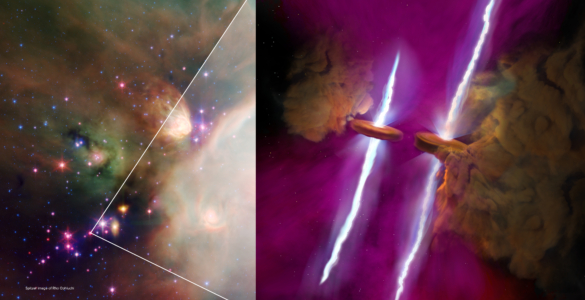
At left, a mid-infrared image of the rho Ophiuchi molecular cloud complex by NASA’s Spitzer Space Telescope, the focus pointing to star system WL20. At right, WL20 expands to reveal an artist’s impression of this new discovery. Astronomers couldn't believe their luck when observations across multiple radio and infrared wavelengths from ALMA and JWST revealed twin disks and jets erupting from a pair of young binary stars in WL20.
It’s Twins! Astronomers Discover Parallel Disks and Jets Erupting From a Pair of Young Stars
June 12, 2024 at 11:15 am | News Release

Most of the Universe is invisible to the human eye. The building blocks of stars are only revealed in…

Showing news items 251 - 260 of 982