

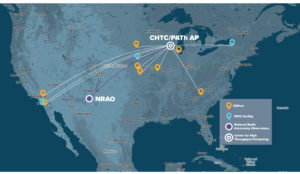
Looking for a more efficient way to process a particularly large VLA data set, to produce one of the deepest radio images of the Hubble Ultra Deep Field (HUDF), made famous by the Hubble Telescope, NRAO staff decided to try a different approach.
New Details of Supermassive Black Hole’s Shadow Revealed
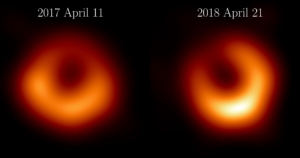
The Event Horizon Telescope (EHT) Collaboration has released new images of supermassive black hole M87*. A recent paper published in the journal Astronomy & Astrophysics presents new images from data collected by the Atacama Large Millimeter/submillimeter Array (ALMA) and several other instruments within the EHT. These new images show a bright ring surrounding a deep central depression, “the shadow of the black hole,” as predicted by general relativity. Excitingly, the brightness peak of the ring has shifted by about 30º compared to the first images, which is consistent with scientists’ theoretical understanding of variability from turbulent material around black holes.

NRAO in the press at AAS 243
New scientific results from the Atacama Large Millimeter/submillimeter Array (ALMA), the Very Large Array (VLA), and Green Bank Observatory…
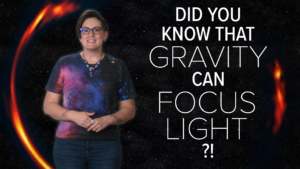
The Baseline #17: Gravitational Lensing: Focusing On The Cosmos
Gravity can focus light like a lens, allowing astronomers to see distant galaxies and explore dark matter. Join our host Summer Ash of the National Radio Astronomy Observatory as she talks about how astronomers use gravitational lensing to study the universe.
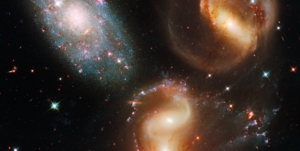
Far, Far Away: Just How Distant Is That Galaxy?
Radio astronomers have observed galaxies billions of light years away. But how do they know just how far away those galaxies are?
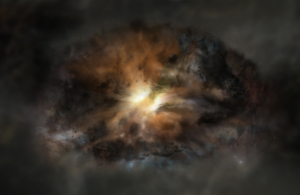
Extreme Galaxy Reveals Clues to Early Supermassive Black Hole Formation
While studying galaxies in the early Universe with the Atacama Large Millimeter/submillimeter Array (ALMA), scientists discovered one of the most extreme galaxies ever recorded in the early Universe. What’s more, it was hiding a unique supermassive black hole (SMBH). The observations could unlock clues about the early formation of these violent giants and how to find them.