

Studies with the VLA indicate that roughly half of the massive black holes in dwarf galaxies are not in the centers of those galaxies. This gives astronomers new insights into the conditions in which similar black holes formed and grew in the early history of the Universe.
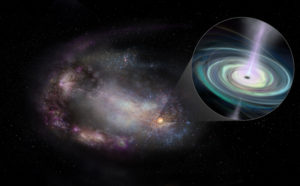

The Turbulent Life of Two Supermassive Black Holes Caught in a Galaxy Crash
An international team of astronomers used ALMA to create the most detailed image yet of the gas surrounding two supermassive black holes in a merging galaxy.
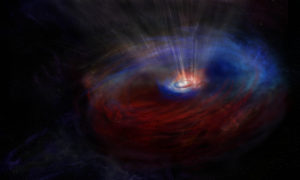
Going Against the Flow Around a Supermassive Black Hole
At the center of a galaxy called NGC 1068, a supermassive black hole hides within a thick doughnut-shaped cloud of dust and gas. When astronomers used ALMA to study this cloud in more detail, they made an unexpected discovery that could explain why supermassive black holes grew so rapidly in the early Universe.
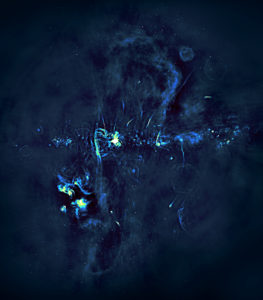
Towering Balloon-like Features Discovered near Center of the Milky Way
An international team of astronomers has discovered one of the largest features ever observed in the center of the Milky Way – a pair of enormous radio-emitting bubbles that tower hundreds of light-years above and below the central region of our galaxy.

ALMA Dives into Black Hole’s ‘Sphere of Influence’
New ALMA observations provide an unprecedented close-up view of a swirling disk of cold interstellar gas rotating around a supermassive black hole.
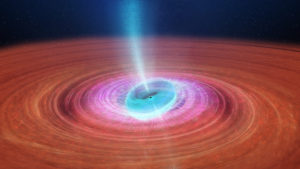
Black Hole’s Tug on Space Pulls Fast-Moving Jets in Rapid Wobble
A spinning black hole pulls in material from a companion star, and its gravitational effect causes ejected jets of material to wobble like a child’s spinning top.